Adol Sagmanovich Khamzin
Ballet Dancer · Professor of Classical Partnering
Leningrad Maly Opera and Ballet Theatre
Vaganova Ballet Academy
My First-Year Pas de Deux Teacher
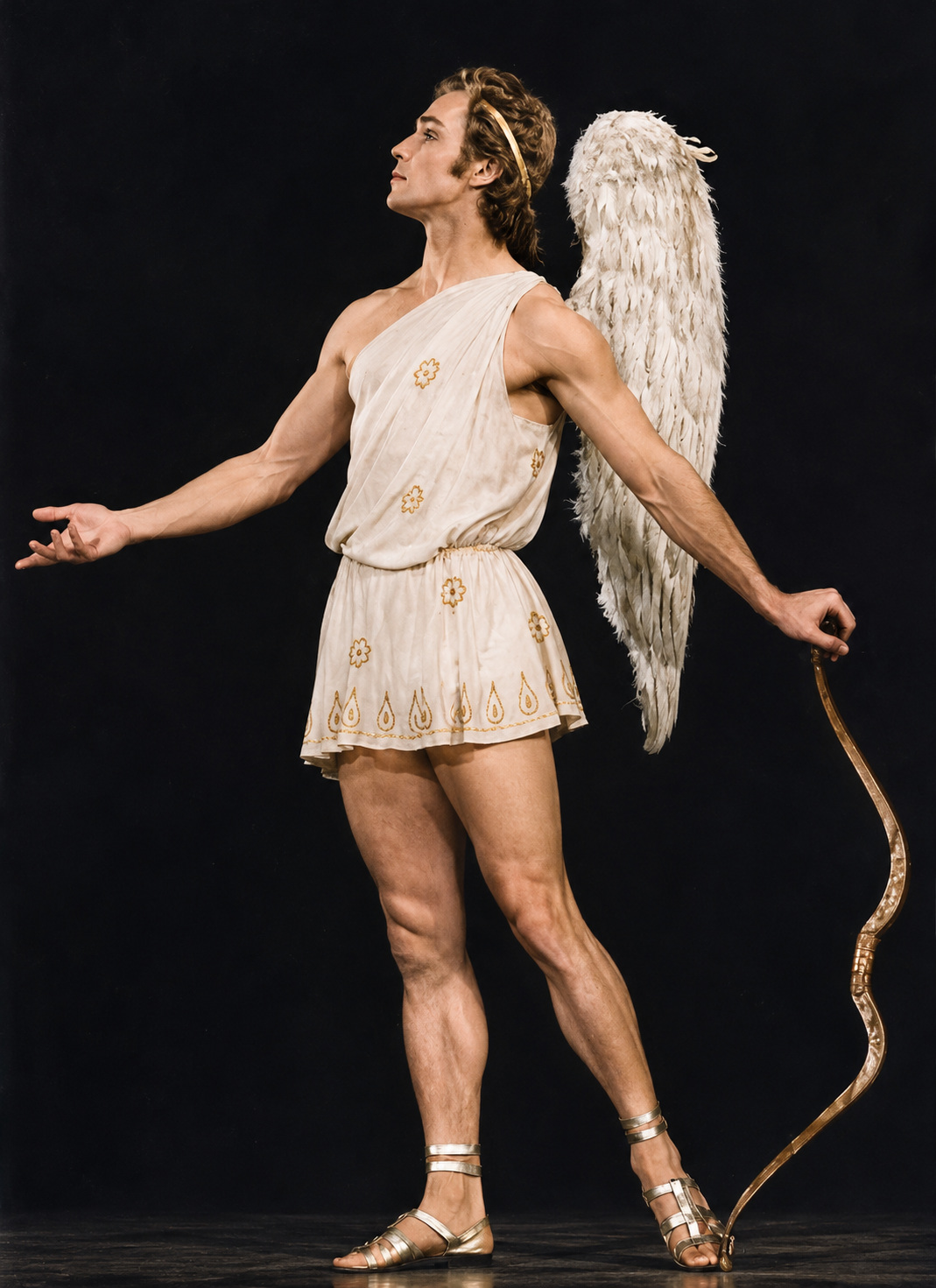
AI-colorized reconstruction of an archival stage photograph.
Adol Sagmanovich Khamzin (1934–2020) was a distinguished Soviet and Russian ballet dancer, professor, and teacher of classical and duet-classical dance. He was awarded the title of Honored Artist of the RSFSR in 1966.
A graduate of the Leningrad Choreographic School, he became one of the leading dancers of the Leningrad Maly Opera and Ballet Theatre, now known as the Mikhailovsky Theatre.
His artistic career was characterized by a combination of academic classical technique, physical strength, lyrical expression, and dramatic characterization.
Following his success on stage, Khamzin devoted many decades to the professional education of ballet dancers at the Vaganova Ballet Academy. His particular area of expertise was classical partnering, including the technique and methodology of the pas de deux.
Adol Sagmanovich Khamzin was my teacher during my first year of studying duet-classical dance at the Leningrad Choreographic School named after Agrippina Vaganova.
Biography
Adol Sagmanovich Khamzin was born on February 7, 1934, in Ufa, in the Soviet Union. His early childhood coincided with the years of the Second World War.
He later moved to Leningrad to receive professional ballet training. His recollections of those years were preserved in an interview published in the academic journal Bulletin of the Vaganova Ballet Academy in 2015.
Khamzin studied at the Leningrad Choreographic School in the class of Alexander Ivanovich Pushkin, one of the outstanding teachers of male classical dance.
Pushkin’s pedagogical legacy was closely associated with the development of highly accomplished male dancers whose technique combined classical precision with freedom of artistic expression.
In 1953, Khamzin graduated from the school and joined the ballet company of the Leningrad Maly Opera and Ballet Theatre.
He remained associated with this theatre until 1975, performing leading roles in classical and contemporary productions.
Artistic Career
Khamzin developed into a leading dancer of the Maly Opera and Ballet Theatre, establishing himself in the lyrical-heroic repertoire.
His classical roles included Prince Siegfried in Swan Lake, Ali in Le Corsaire, and leading parts in Paquita and Daphnis and Chloe.
He was particularly associated with the choreographic work of Konstantin Boyarsky, appearing in several significant productions and revivals.
Among his original roles were Eros in Eros and Paolo in Francesca da Rimini (1959), as well as a leading role in Classical Symphony.
He also performed the title role in Orpheus and Ivan Tsarevich in The Firebird, in productions associated with Boyarsky’s revival of the choreographic legacy of Michel Fokine.
Other notable roles included Olaf in Solveig, Menzer in Seven Beauties, and the Hooligan in The Young Lady and the Hooligan.
His performances demonstrated an ability to unite the disciplined structure of classical dance with expressive characterization. Contemporary ballet reference works particularly emphasized the effectiveness of his dramatic interpretation in heroic and lyrical roles.
In 1957, he received first prize at the World Festival of Youth and Students in Moscow. In 1966, his artistic achievements were recognized with the honorary title of Honored Artist of the RSFSR.
After concluding his performing career at the theatre, Khamzin served as artistic director of the Leningrad Ballet on Ice from 1975 to 1980.
Pedagogical Career
Khamzin began his pedagogical activity while still working as a professional dancer. By the mid-1960s, he was teaching classical and duet-classical dance at the Leningrad Choreographic School.
Classical partnering became the central specialization of his teaching career. The discipline combines individual technical preparation with the coordinated movement of two dancers.
The systematic study of the pas de deux includes supported balances, promenades, assisted rotations, lifts, and the coordination of complex choreographic sequences.
In the Vaganova tradition, these technical elements are not isolated from the artistic content of the dance. Partnering also requires musical responsiveness, dramatic interaction, mutual trust, and precise understanding of the relationship between the dancers.
Khamzin’s experience as a leading stage partner provided an important practical foundation for his teaching methods.
His professional activity extended beyond Leningrad. He also taught at dance institutions in Winston-Salem, North Carolina, and Budapest, Hungary.
Over the following decades, Khamzin continued his work at the Vaganova Ballet Academy, eventually becoming a professor in the field of classical partnering methodology.
In the later years of his career, he participated in the preparation of younger teachers and taught the methodology of duet-classical dance at the Academy’s pedagogical faculty.
His long teaching career represented an important link between the professional theatrical practice of the mid-twentieth century and the continued development of the Vaganova educational tradition.
Artistic Partnership with Natalia Yananis
An important part of Khamzin’s artistic biography was his partnership with Natalia Stanislavovna Yananis, an accomplished ballerina of the Leningrad Maly Opera and Ballet Theatre.
Yananis graduated from the Leningrad Choreographic School in 1956 and subsequently became a leading performer in classical and contemporary ballet productions.
Khamzin and Yananis performed together at the Maly Theatre, including in Konstantin Boyarsky’s Classical Symphony. Their artistic partnership also developed into a lifelong marriage.
Both artists later became distinguished teachers associated with the Vaganova Ballet Academy, contributing to different but complementary areas of professional ballet education.
My Teacher
Adol Sagmanovich Khamzin was my teacher during the first year of my training in duet-classical dance at the Leningrad Choreographic School named after Agrippina Vaganova.
This stage of professional education introduced the systematic study of classical partnering as a distinct discipline, requiring not only individual mastery of classical technique but also the development of coordinated movement between partners.
His instruction formed part of my professional preparation within the Vaganova system, connecting the technical foundations of duet-classical dance with the traditions of theatrical performance.
Place in My Pedagogical Lineage
Adol Sagmanovich Khamzin occupies a significant place in my pedagogical lineage as a direct teacher of duet-classical dance.
His own professional education under Alexander Ivanovich Pushkin connected his teaching with one of the important pedagogical traditions of male classical dance in Leningrad.
His subsequent career at the Maly Opera and Ballet Theatre added a substantial body of practical stage experience to that foundation.
The transmission of this experience through the teaching of classical partnering represents an essential dimension of the continuity between the theatre and the ballet school.
In my own education, Khamzin’s instruction belonged to the initial stage of mastering the principles and techniques of classical pas de deux.
The genealogy connects the historical predecessors of Nikolai Gustavovich Legat with the training of Alexander Ivanovich Pushkin, who studied both at Legat’s private ballet school and under Vladimir Ivanovich Ponomaryov at the Petrograd Theatre School. Pushkin subsequently taught classical dance to Adol Sagmanovich Khamzin, who taught duet-classical dance to Aleksei Fomkin.
The Pedagogical Predecessors of Nikolai Legat
The historical genealogy of Nikolai Gustavovich Legat includes four pedagogical predecessors represented in the broader genealogy of the Saint Petersburg classical ballet tradition: Gustav Legat, N. I. Volkov, Pavel Gerdt, and Christian Johansson.
These connections locate Nikolai Legat within the nineteenth-century development of Russian academic ballet training and its transmission into the twentieth century.
Nikolai Legat and Vladimir Ponomaryov: The Education of Alexander Pushkin
Alexander Ivanovich Pushkin received part of his ballet education at the private school of Nikolai Gustavovich Legat.
He subsequently studied at the Petrograd Theatre School, where Vladimir Ivanovich Ponomaryov was his teacher.
These two pedagogical relationships represent successive stages of Pushkin’s professional education and are therefore shown as separate incoming connections in the diagram.
Alexander Pushkin: Classical Dance
Alexander Ivanovich Pushkin was Adol Khamzin’s teacher of classical dance at the Leningrad Choreographic School. Khamzin graduated from his class in 1953.
This relationship places Khamzin within the pedagogical tradition of male classical dance associated with Pushkin, whose teaching contributed to the professional formation of several outstanding ballet dancers.
From Classical Dance to Classical Partnering
Khamzin’s professional formation under Pushkin provided a foundation in classical technique. His subsequent performing career at the Leningrad Maly Opera and Ballet Theatre expanded that foundation through practical experience in theatrical repertoire and classical partnering.
Classical partnering later became the principal specialization of his pedagogical career at the Vaganova Ballet Academy. His teaching connected the academic discipline of classical dance with the technical and artistic demands of the pas de deux.
Transmission to Aleksei Fomkin
Adol Sagmanovich Khamzin was my teacher during the first year of my studies in duet-classical dance at the Leningrad Choreographic School.
His instruction introduced the systematic foundations of classical partnering, including the coordination of movements between dancers, supported elements, and the technical organization of the pas de deux.
In this way, Khamzin represents a direct connection between the classical dance tradition transmitted through Alexander Pushkin and my own professional education in the Vaganova system.
Historical and Methodological Note. This genealogy distinguishes successive stages and disciplines of ballet education. Nikolai Legat and Vladimir Ponomaryov are represented as teachers of Alexander Pushkin. Pushkin is identified as Khamzin’s teacher of classical dance, while Khamzin’s direct instruction of Aleksei Fomkin concerned duet-classical dance. The four earlier connections to Nikolai Legat follow the broader historical pedagogical genealogy. The diagram represents educational relationships, not a claim that the same teaching methodology was transmitted unchanged across all generations.
Historical Photo Gallery
Archival stage photographs of Adol Sagmanovich Khamzin and Natalia Stanislavovna Yananis, presented in modern AI-colorized reconstructions.
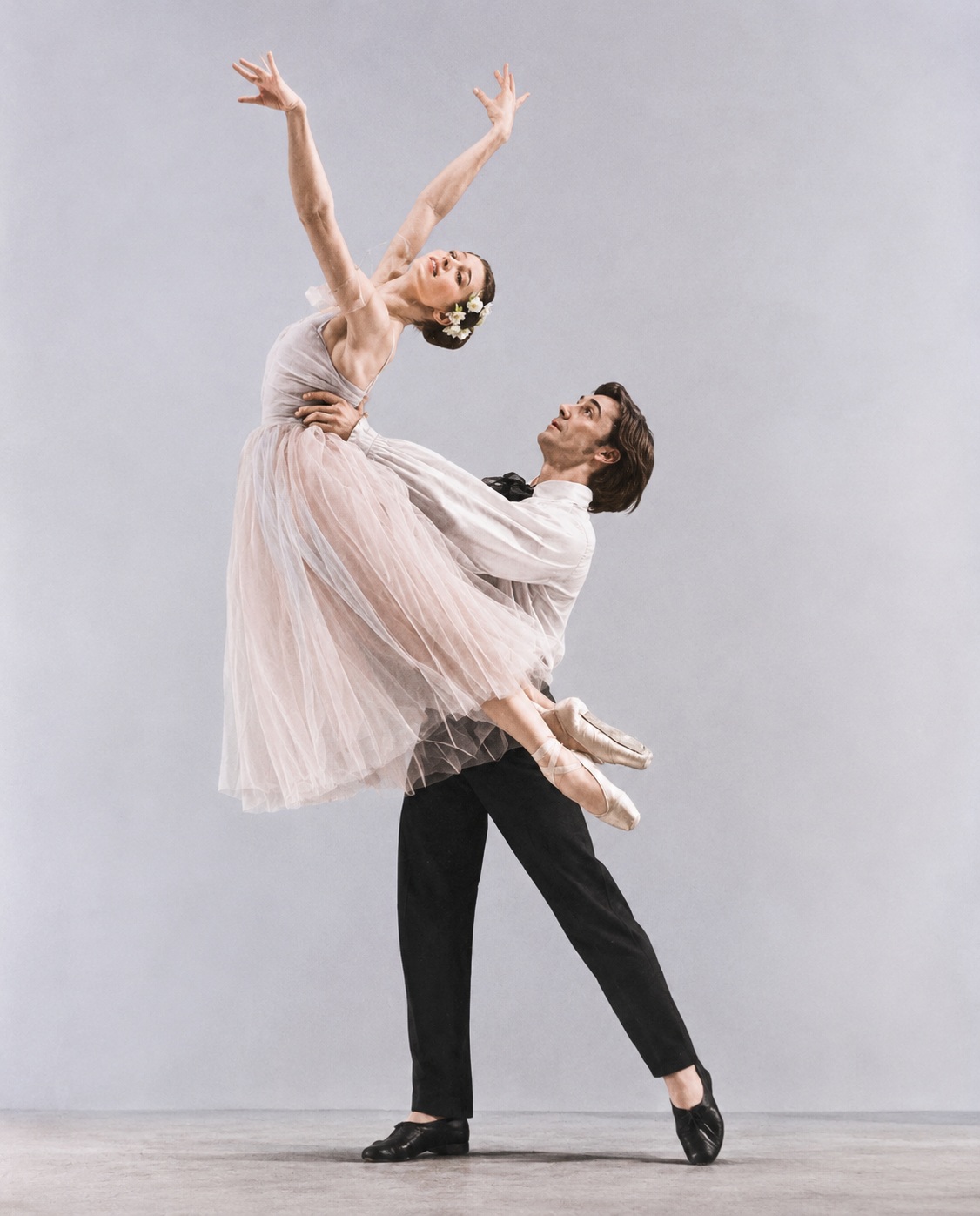
AI-colorized reconstruction of an archival photograph.
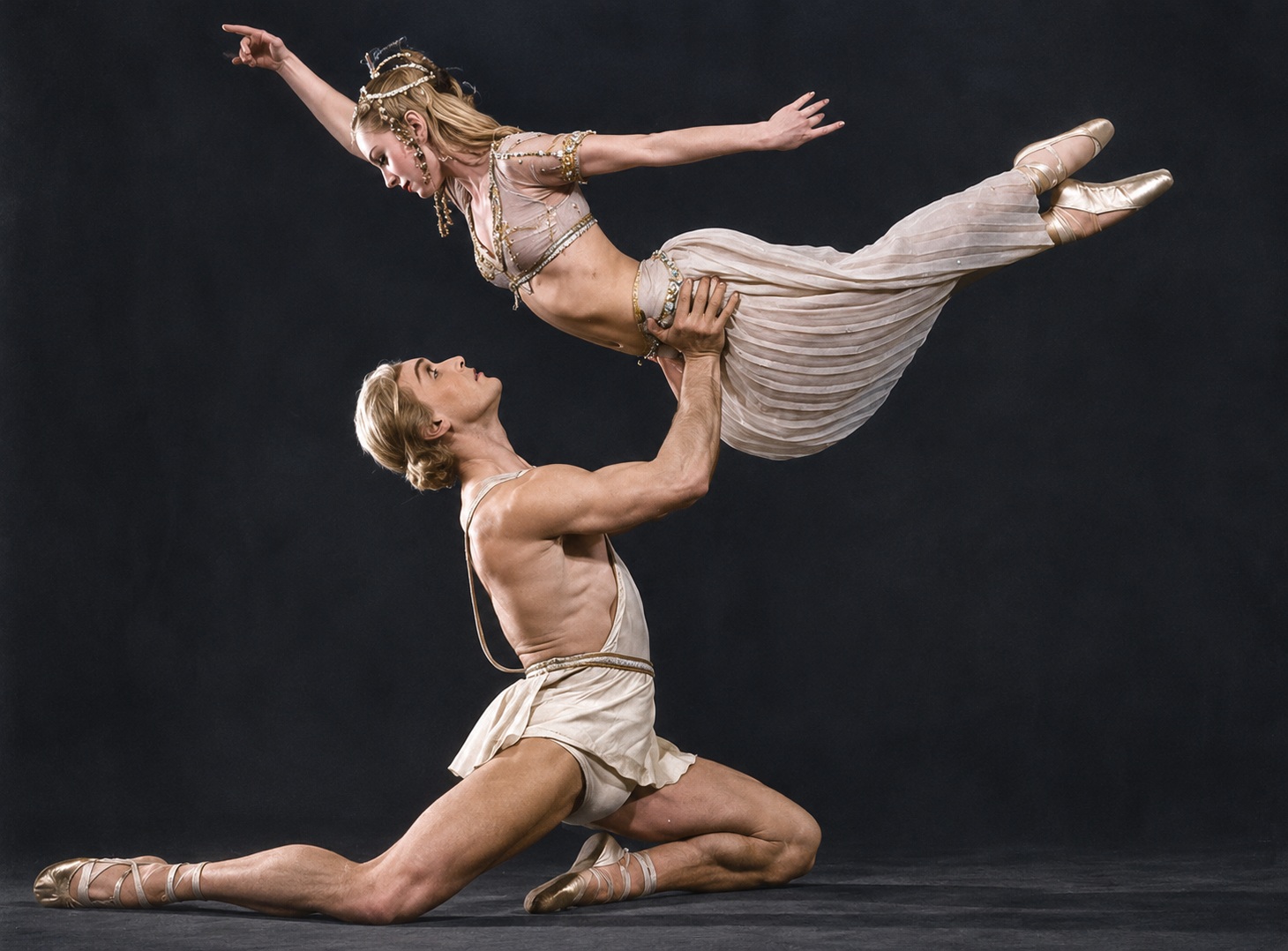
AI-colorized reconstruction of an archival photograph.
Historical Sources
A. S. Khamzin. “I Was a Courtyard Boy…” Interview published in Bulletin of the Vaganova Ballet Academy, No. 2 (37), 2015. Read the publication
Saint Petersburg Philharmonia. Historical biographical archive: Adol Khamzin. Read the biography
A. Degen and I. Stupnikov. “Adol Sagmanovich Khamzin.” Ballet biographical reference. Read the biography
Vaganova Ballet Academy. Biographical information on Natalia Stanislavovna Yananis. Academy biography